Remember the 100+ hours of STEM certification all of the math and science teachers are completing, on our campus? This past weekend, a group of us got together, so we could collaborate on the more challenging indicators. The challenge comes from the focus being on science classrooms, rather than math.
As we sat there, talking about lessons in our classroom and how we could extend the learning or had to revamp our delivery, learning was happening and the conversations were great. The "infamous" indicator, as I now refer to it, focused on investigable questions. After some Google "research," I learned that these questions do not have a yes or no answer.
I submitted indicator 13 of my STEM certification, for the second time. For the second time, I received a 0. For the second time, I felt like a failure. For the second time, the feeling of defeat took over my heart, mind and body. A huge reality check struck me in the face, as I quickly realized how our kids feel when they receive a 0, when they've tried and done the best they can!
Starting my Monday morning off with the 0 out of 3 points earned notification, wasn't how I typically start my week. I was in disbelief that I had gotten a 0, as this goes against everything I believe in, when it comes to learning. It brought me back to my junior year of high school, when my English teacher, used red pen all over my essay. Hence I only use fun, bright colors to assess learning opportunities, as well as checks and circles, rather than x's. Those small details impact our learners more than we realize.
So now we wait to see what my new grade is, if the reflection, thought and effort will improve the grade and bring back the feeling of success. I am determined to be successful and now allow a 0 to define who I am as a learner!
This past week, we were asked to nominate our peers whom we believe exemplifies what it means to be teacher of the year. On Wednesday, January 18, I received an email from our principal letting me know that I was one of three staff members chosen as a finalist for this honor. Being chosen as one of the top 3 finalist for our school's teacher of the year was quite the honor and shock, considering I've only been part of the Falcon family for what feels like 4 short months!
Meet my best friend, Hayley, was chosen as TOY for elementary during the 2014-2015 school year. During this time, she was teaching 3rd grade ELA and finishing up her master's of education in child development. Hayley's focus in our classroom is to foster an environment where all learners are able to achieve success, through the power of play. Being an advocate for recess has been on the top of Hayley's priorities. She believes that movement and fresh air are vital to a child's academic achievements.
Hayley was named Region IX Teacher of the Year, which came as a huge surprise to her! She is extremely humble and always gives credit to everyone else for their contributions. (I'm just like her!) Hayley believes her relationships with her teaching partners, yielded the success that earned her the title of Teacher of the Year, for both Graham ISD and Region IX..
October 2015 we headed to Austin for her recognition as Region IX Teacher of Year
Hayley and I met at the beginning of my teaching career, when both of us were teaching at E. Ray Elementary. She was teaching kindergarten and I was teaching 5th grade. Months went by as a friendship began to flourish. We would soon create lessons where we would combine our learners. There was nothing more exciting for any of us then the day we got to work with our buddies!
Because of Hayley's diverse teaching experiences, ranging from teaching math at our alternative school for 7th graders to high school seniors to teaching our youngest learners in the district in kindergarten, she models a philosophy that all children can achieve success, through differentiated and individualized instruction.
Hayley has encouraged me, along with her fellow teaching partners, to take risks and do what's best for kids. She serves as an advocate for integrating ELA with all content areas, which explains why I have such a huge library of children's books for my secondary classroom! Implementing centers in my classroom was the norm, thanks to her guidance and suggestions on how to better meet the needs of my learners.
What I treasure most is that despite living miles apart and teaching different grade levels, we talk daily about the successes in our classroom, as well as the obstacles along the way. It's these conversations that allow both of us time to reflect on our practices and encourage both of us to want to take risks and implement new strategies. Hayley continues to leave a huge impact on who I am as a learner, teacher and person!
Below is the criteria our district uses for selecting TOY:
Guidelines for Selecting a Candidate:
1. Be a highly effective classroom teacher as evidenced by student results.
2. Must have bachelor's degree and a valid teacher’s certificate.
3. Be engaged in or has leadership role in professional learning for themselves and/or others.
4. Contribute to the professional community and the school community and culture in order to strengthen the teaching profession.
5. Examples of community involvement including, but not limited to, serving in a non-profit agency, teaching Sunday School, working at a youth center as a volunteer, etc.
6. Use technology to enhance student’s learning and depth of understanding.
7. Be seen as a positive influence among staff, parents and community members.
8. Create a classroom that strives to reach all learners using a variety of techniques.
9. Student focused.
How would you rate your self? The next 6 posts will be part of a series on what makes one a candidate for teacher of the year.
One of the first things I was told during my student teaching was to befriend the office staff and the custodial staff, as these are the people who keep the school operating behind the scenes. After all, who is going to help when you need emergency copies made or help cleaning up a spill in your classroom? That's right the amazing office & custodial staff!
Because of my love of arts and crafts, we are constantly cutting and pasting, which in turn means a lot of paper on the floor. Despite having trashcans around the room, we can always find remnants of our creations on the floor, along with highlighters, glue sticks and markers! Many days I'm found working in our classroom, with a group of students way past the 3:50 dismissal bell. As the kids are working, I usually am sweeping up our mess from the day. After all, it's not Ms. Brenda's job to clean up after us! I also know how hard it is to get around the groups of desks, so I try to sweep it all to the area by the trashcans.
A sweet note from Ms. Brenda
Over time, kids have begun to help sweep our room, without being asked. It's this ownership of behavior that makes my heart happy! They know how much it helps others, as well as how happy it makes everyone. Why not make somebody's day just a little bit brighter?
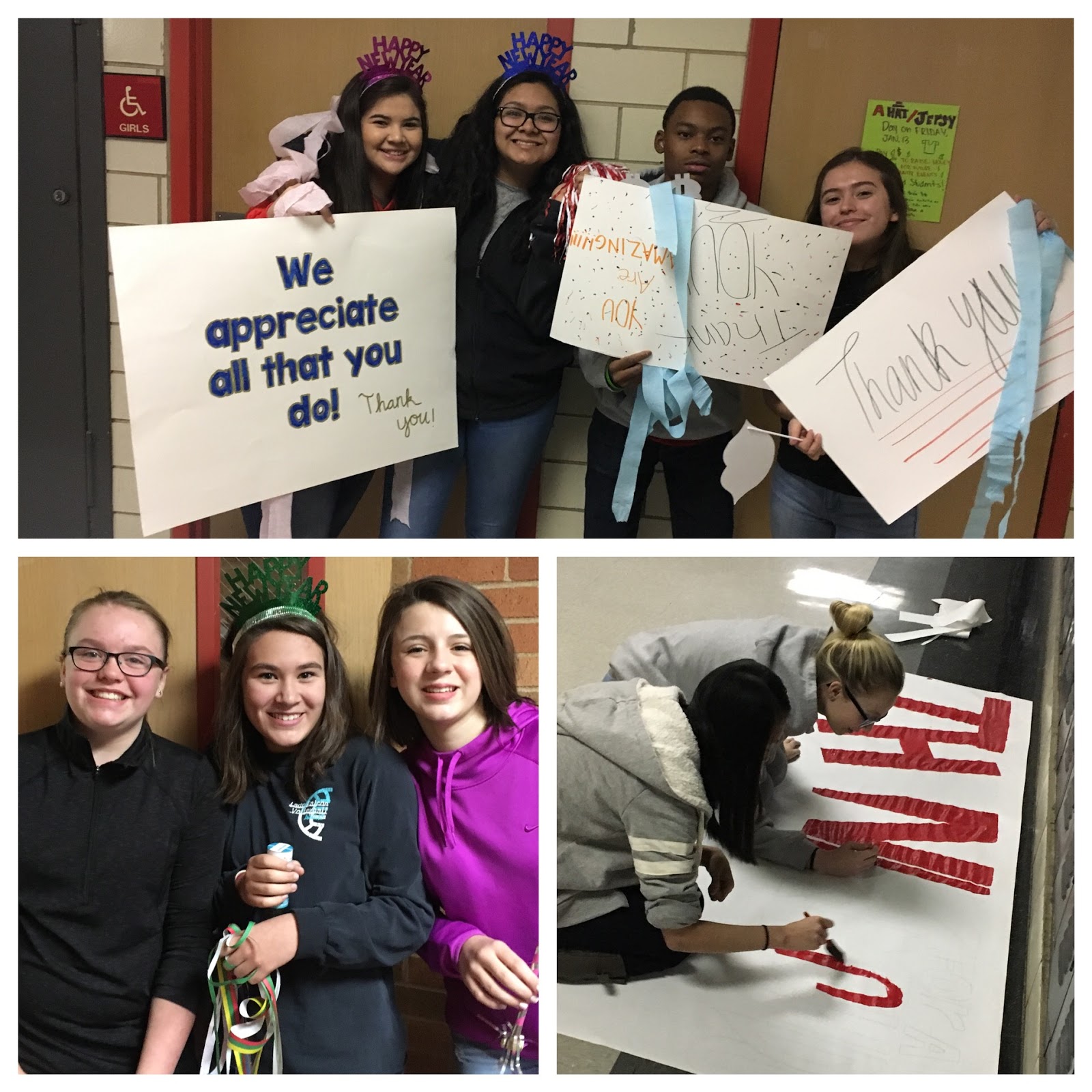
During the third six weeks' our Falcon Way group, Courage House, focused on appreciation! We chose to show our appreciation for our custodial staff. Students collaborated and shared ideas about how they could help and one was to start a trend of cleaning up after each lunch.
Students quickly signed up for a time to help and encouraged their classmates to also join in helping. The timing of this effort couldn't have been better planned as our head custodian was out on medical leave and Ms. Brenda was having to man the cafeteria by herself. It was all hands-on deck from my 4th period as we always pick up trash on our way back to class! In fact this is part of what "the dream team does," according to a few of my girls :)
I'm proud that so many of our kids don't even question picking up somebody else's trash or mind helping clean up in the cafeteria. Again it's the small actions of one that brighten the lives of so many others!
After Winter Break, all Courage House members helped create a video of appreciation! It took a few recordings, but the kids were amazing. In fact they did such a great job, that Ms. Brenda was brought to tears!
How do you show appreciation for those you work with at school?
When we returned from winter break, our Algebra learners hit the road running and began our unit over polynomials. As I told both classes, this is one of my favorite units and to be prepared for an over excited teacher! This of course brought smiles to their faces and reignited their passion for growing in their mathematical knowledge.
To kick off our unit, learners focused on naming polynomials as well as adding and subtracting polynomials. Much to their surprise, they already had experiences with both concepts! The relief was much needed after learning about exponents and radicals, where their brains were stretched and thinking outside of the box occurred on a daily basis.
We focused on finding the area and perimeter of various figures, which would serve as a foundation as we began to multiply and divide polynomials. To kick off learning about multiplying polynomials, I had learners text their parents asking if they remembered using FOIL in math.
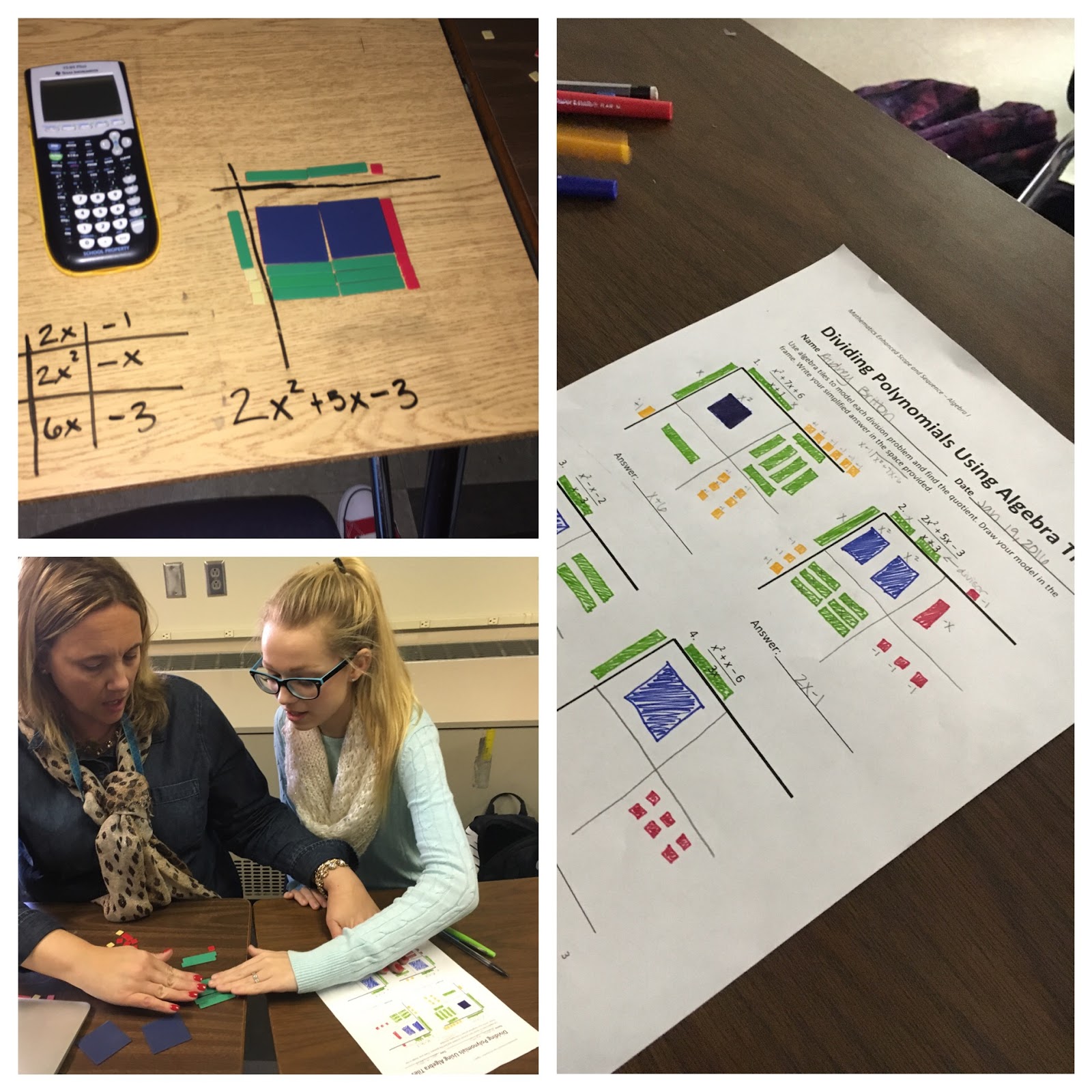
As the dings of arriving text messages filled the air and learners were excited to share their parents' responses, we pulled out the algebra tiles and began to multiply polynomials! From the sounds in our classroom, plus the need to use our fancy colored pens, learners were excited to create. Little did they realize their creations were creating concrete examples for their minds to use to make connects to an abstract concept!
As we continued to build our models with algebra tiles, we connected our "playing" with the box method. Learners were amazed at how easy they were able to explain how to find the product of polynomials by using either method. To stretch their thinking I gave various representations of the same problem and had learners recreate the other representations.
Given 1 representation & asked to create the others
I'm quite impressed with the learners of room 27 this week, as they embraced being a kid again and playing in math! Too many times we get caught up in being an advanced academic student, rather than embracing a growth mindset. This week was one that was filled with critical thinking, problem solving and most of all successful learners!
Based on the success of these learning opportunities, we began division on Friday! Thinking was challenged and connections were made. One learner was overhead saying, "This is hard. My brain can't understand this." I was quick to remind him that we were all going to stretch our thinking and learn about dividing polynomials in a method other than an algorithm.
Pages began to be flipped, algebra tiles began to spill on the desks and boxes began to be drawn on the desk. Thinking backwards from what they knew about multiplying polynomials allowed learners to create their own solutions for dividing polynomials.
As part of their assessment over polynomials, learners will be asked to write a letter to a 5th grader explaining how to use concrete examples to explain how to solve problems with polynomials.